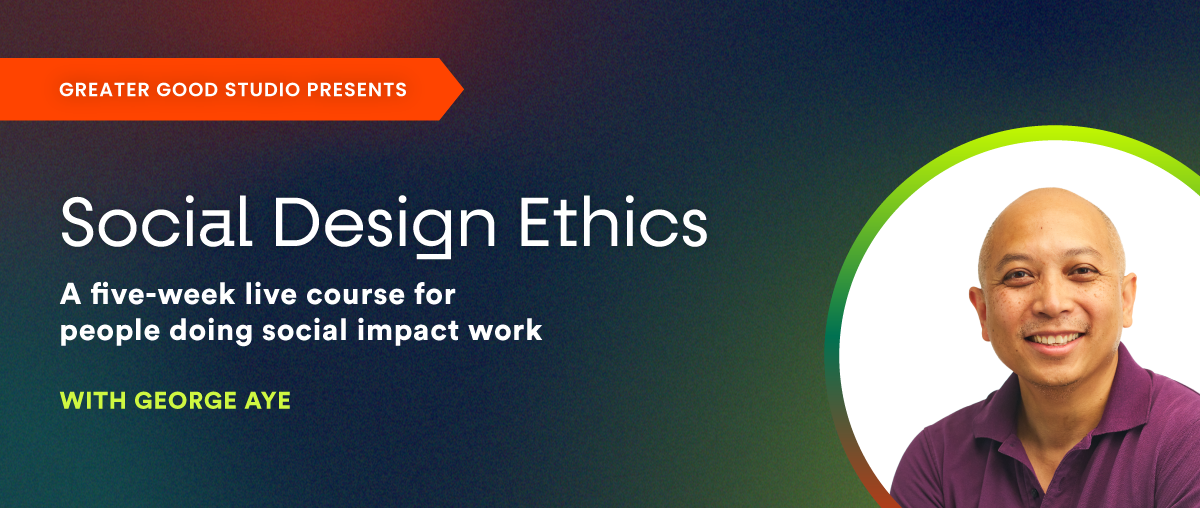
Why we’re offering a Social Design Ethics Class
The field of social design lacks an industry-wide code of ethics or shared standards of practice. And that gap means the work we do risks doing more harm than good. When you have reservations, you are forced to raise them in isolation, often without institutional support.
Most designers interested in social impact work don’t receive the training they need for the ethical questions they will face. And while many professionals in the social impact space may have ethical frameworks from their backgrounds, it can still be hard to know what to do when faced with intense pressure from a funder. Questions like, “Should I take on this project? Should I push back on this client? How do I bring up my concerns with my boss without getting in trouble? ” are all fraught with professional and personal risk.
Who this course is for
We designed this course for Pissed-Off Optimists: mid-career professionals who hold two things at once: a clear-eyed recognition of injustice, and an unshakable belief that collective change is possible.
You might be a designer, researcher, strategist, program manager, or consultant. You might work inside a nonprofit, a foundation, a government agency, a design firm, or on your own. What you have in common with everyone else in the cohort is this: you’re often the only person in the room asking these questions, and that gets lonely.
This course will not be a deep dive into the abstract, academic discussion of philosophy, but rather a practical guide to navigate the kinds of ethical and moral compromises that often occur in our work. Without dedicated time to practice sensing those concerns, and space to build an argument in response, the terms of your personal code will often be set for you by your workplace.
What is the Social Design Ethics Class?
Over five weeks, you’ll work through the essential questions every social designer faces:
- Week 1: When have I felt powerful, and when have I felt powerless?
- Week 2: How can I say no to work when I have to pay my bills?
- Week 3: How do I work with people who mean well but cause harm?
- Week 4: What does it mean to take care of the people my work touches?
- Week 5: What’s the cost of speaking up? What’s the cost if I don’t?
Each two-hour session is live on Zoom, facilitated by George Aye. You’ll spend most of your time working in small groups, responding to prompting questions and scenarios. This includes the tools that Greater Good Studio uses in its own practice, including the Gut Check, a tool we use before taking on any new project. Between sessions, you’ll receive readings that sharpen your instincts for where your own boundaries are. Expect about 30-60 minutes of reading or homework per week.
What you’ll leave with
You’ll leave with new frameworks and tools for navigating future moments of compromise, but more importantly, you’ll have new language to make your arguments in your own professional setting, and a cohort of peers who understand exactly what you’re navigating. The hardest ethical decisions are the ones where there are real stakes attached, and they’re easier to face when you’re not facing them alone.
Course details
- Duration: Five weeks
- Dates: Tuesdays – July 21, July 28, August 4, August 11, and August 18.
- Time: 6-8 pm CT
- Format: Live on Zoom
- Maximum capacity of 20 students
- Office Hours: Up to three hours of group Zoom office hours following the final session
This course runs on trust. Everyone, including the instructor, is expected to uphold to our community agreements.
Syllabus/Week-by-week outline
Week 1: When have I felt powerful, and when have I felt powerless?
- Trace where power has lifted you, where it’s held you back, and where you’ve held it over others
- Set the cohort’s working agreements, including how you’ll hold the instructor to them
Week 2: How can I say no to work when I have to pay my bills?
- Build your own gut check, the screening tool Greater Good Studio runs every Monday before taking on new work
- Test your draft questions against a real project brief and keep only what works
Week 3: How do I work with people who mean well but cause harm?
- Run your gut check on a foundation case that keeps getting more complicated
- Decide with your group whether to continue, restructure, or walk away. Then defend it.
Week 4: What does it mean to take care of the people my work touches?
- Why care is a higher standard than “do no harm,” especially in research
- Write a private letter to people a project failed: what happened, what you’d do differently, what repair might look like
Week 5: What’s the cost of saying no? What’s the cost of saying yes?
- Bring a real decision you’re weighing right now and work it through with peers who only ask questions, never give advice
- Ask George anything about what publishing Surviving IDEO cost him.
Need to make the case to your employer?
Many participants use professional development budgets to cover this course. We’ve drafted a justification email you can adapt and send to your manager or funder. It frames the course the way it actually works in practice: helping your organization spot problems early, before they become expensive ones.
[Download the sponsor email template]
About your instructor
George Aye is Co-Founder and Co-Executive Director of Greater Good Studio and the author of Surviving IDEO and Dismantling White Supremacy Culture Within AIGA. He is an outspoken critic of conventional forms of human-centered design and brings over 20 years of teaching experience from Northwestern University and the School of the Art Institute of Chicago. He speaks frequently across the US and internationally.
This course draws on 15 years of Greater Good Studio’s methods and mindsets. For the past five years, George taught it as a ten-week class to graduate students at Northwestern University, where it became a core component of the Master of Science in Engineering Design Innovation (EDI) program.
Questions?
Email us at change@greatergoodstudio.com.
Registration closed
Classes start on July 21st, 2026, 6–8 pm CT for five weeks, ending on August 18th, 2026. Registration closed on July 10th, 04:59 pm CT.
This pilot offering is available at a special introductory rate of $599 (regularly $899).